
Queens Chronicle, Naeisha Rose, 12/12/25
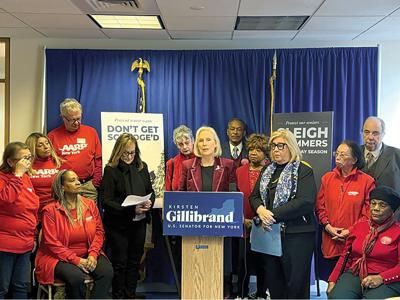
U.S. Sen. Kirsten Gillibrand, at podium, with members of AARP and the New York StateWide Senior Action Council, advocating for her federal anti-scam bill. Photo by Adrien Lesser / U.S. Senate
The holidays are a time when people come together for good tidings and good cheer, but for seniors it is also a period when they get singled out for scams.
To sleigh scammers, U.S. Sen. Kirsten Gillibrand (D-NY), the ranking member of the Senate Aging Committee, last Thursday introduced the National Strategy for Combating Scams Act, legislation that would combine the efforts of 13 agencies, currently working independently with different mandates to fight the criminal activity, under the purview of the Federal Bureau of Investigations. She held a press conference with members of the AARP and New York StateWide Senior Action Council in Manhattan advocating for the bill Dec. 9.
“In 2024, Americans had over $16 billion stolen from them in scam attacks,” Gillibrand said via text. “Hardworkig New Yorkers, including residents in Queens, lost their hard-earned money. … We need to protect Americans from losing their paychecks, savings, and holiday gifts.”
The purpose of the legislation is to enhance federal coordination and effectiveness in fighting scams, with the FBI taking the lead, as criminals increasingly utilize advanced tools such as generative artificial intelligence and voice deepfakes to deceive victims.
When reached about the legislation, the FBI declined to comment. The Queens District Attorney’s Office and the NYPD were not available to comment on the legislation or provide local stats about scams.
Despite the current political landscape, in which Democrats and Republicans couldn’t be further apart, as if a holiday miracle, elected officials from across the aisle are supporting the bill.
“I’m proud to introduce the bipartisan … act to help make sure seniors don’t get scrooged this holiday season,” said Gillibrand in a statement. “It’s clear that we need a coordinated national strategy to tackle the increasingly sophisticated scams targeting our seniors, and this legislation would bring that to fruition.”
Some of the supporters of the bill include U.S. Sens. Mark Kelly (D-Ariz.), Ashley Moody (R-Fla.) and Rick Scott (R-Fla.), along with U.S. Reps. Gabe Amo (D-RI) and Derek Schmidt (R-Kan.).
“Families across the country are being hammered by increasingly sophisticated scams, and Washington has been far too slow to respond,” said Scott in a statement. “As chairman of the U.S. Senate Special Committee on Aging, I am proud to join Ranking Member Gillibrand in this bipartisan effort to finally bring federal agencies together, cut the duplication, and create a real national plan to protect seniors and hardworking Americans.
“After the findings of our fraud report, it’s clear we need a coordinated strategy, not more bureaucracy or new spending, and this bill delivers exactly that. I’m proud to help lead this charge to crack down on criminals and keep Americans safe.”
The U.S. Government Accountability Office, the agency that identified the 13 agencies involved in anti-scam work and recommended the FBI as the lead agency, said in April that based on banking data filed in 2021, the Treasury estimated that impersonation-related suspicious activity cost Americans $200 billion. The scammers impersonate a potential romantic partner, employer or a customer representative to get money.
The office of state Attorney General Tish James said seniors are also targeted by scammers pretending to offer big prizes and phony opportunities; people claiming to be from a financial institution protecting victims’ funds from foreign hackers; and those impersonating government agency employees, who will send targets follow-up emails with links and pop-ups, along with fake government letterheads and phone numbers.
The OAG said scammers will urge victims to share their bank account information over the phone, swear them to secrecy and often ask for money to be moved via wire transfer, cash or cryptocurrency.
If someone has been a victim of a scam, the OAG said to call 1 (800) 771-7755 or reach out to its Bureau of Consumer Frauds at this link: tinyurl.com/yney82jp. People may also check or freeze their credit reports at annualcreditreport.com or go to major credit reporting agencies such as Experian, TransUnion, Equifax and Innovis for additonal help.
The NSCSA, also known as S.3355, was read twice and referred to the Senate Committee on the Judiciary Dec. 4. Its companion bill, HR 6425, was introduced by Amo, also on Dec. 4, and referred to the House’s Judiciary, Energy and Commerce and Financial Services committees the same day.
“I look forward to working with my colleagues on both sides of the aisle to get this vital bill across the finish line,” said Gillibrand.